SIP Calculator India: How Much Do You Need to Invest to Reach Your Goal?
SIP Calculator India: How Much Do You Need to Invest to Reach Your Goal?
A Systematic Investment Plan (SIP) is the simplest, most powerful wealth-building tool available to Indian retail investors. You choose an amount, pick a mutual fund, and every month — automatically — that amount is invested. No timing the market. No waiting for the "right moment."
The mathematics of SIP is straightforward. What's hard is the discipline to keep going. This guide gives you every number you need — how much to invest for every major financial goal — and the psychological framing to stick with it.
The Core SIP Formula
SIP corpus = P × [(1 + r)ⁿ – 1] / r × (1 + r)
Where:
- P = monthly investment amount
- r = monthly interest rate (annual rate ÷ 12)
- n = total number of months invested
You don't need to calculate this manually — use the interactive calculator on this page. But understanding the formula helps you grasp why these three levers — amount, return, and time — work the way they do.
Key SIP Scenarios: ₹1,000 to ₹50,000/Month
At 12% Expected Annual Return (Nifty 50 long-term average)
| Monthly SIP | 5 Years | 10 Years | 15 Years | 20 Years | 25 Years |
|---|---|---|---|---|---|
| ₹1,000 | ₹82K | ₹2.3L | ₹5.0L | ₹9.9L | ₹18.8L |
| ₹3,000 | ₹2.5L | ₹7.0L | ₹15.0L | ₹29.7L | ₹56.4L |
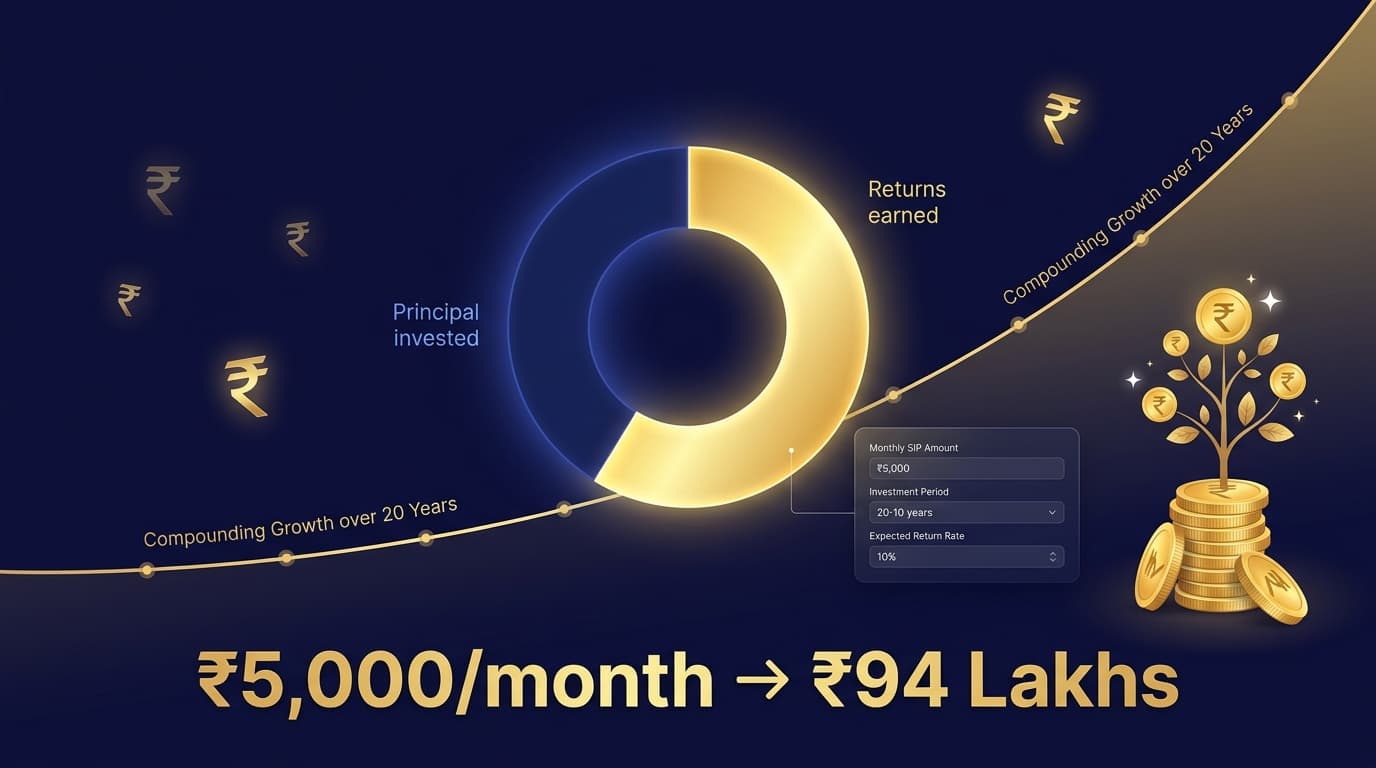
| ₹5,000 | ₹4.1L | ₹11.6L | ₹25.0L | ₹49.6L | ₹94.1L |
| ₹10,000 | ₹8.2L | ₹23.2L | ₹50.1L | ₹99.2L | ₹1.88Cr |
| ₹15,000 | ₹12.3L | ₹34.8L | ₹75.1L | ₹1.49Cr | ₹2.82Cr |
| ₹25,000 | ₹20.6L | ₹58.1L | ₹1.25Cr | ₹2.48Cr | ₹4.70Cr |
| ₹50,000 | ₹41.1L | ₹1.16Cr | ₹2.51Cr | ₹4.96Cr | ₹9.40Cr |
At 15% Expected Return (actively managed mid-cap, small-cap average)
| Monthly SIP | 5 Years | 10 Years | 15 Years | 20 Years |
|---|---|---|---|---|
| ₹5,000 | ₹4.5L | ₹13.9L | ₹33.8L | ₹75.8L |
| ₹10,000 | ₹8.9L | ₹27.9L | ₹67.7L | ₹1.51Cr |
| ₹25,000 | ₹22.3L | ₹69.7L | ₹1.69Cr | ₹3.78Cr |
Past returns of Nifty 50 TRI over 20 years: ~14.5% CAGR. Using 12% for conservative projections, 15% for optimistic.
Goal-Based SIP: How Much to Invest for Each Target
Enjoyed this post?
Get our weekly digest delivered free.
🎯 Goal: ₹1 Crore
| Time Horizon | Required Monthly SIP (at 12%) | Required Monthly SIP (at 15%) |
|---|---|---|
| 30 years | ₹2,870 | ₹1,200 |
| 25 years | ₹5,320 | ₹2,680 |
| 20 years | ₹10,085 | ₹5,800 |
| 15 years | ₹19,965 | ₹13,500 |
| 10 years | ₹43,130 | ₹35,800 |
| 5 years | ₹1,21,500 | ₹1,11,000 |
Insight: Starting at 25 instead of 35 to reach ₹1 Cr cuts your required SIP from ₹19,965 to ₹5,320/month — a ₹14,645/month difference — just for 10 more years of compounding.
🎯 Goal: ₹2 Crore
| Time Horizon | Required Monthly SIP (at 12%) |
|---|---|
| 30 years | ₹5,740 |
| 25 years | ₹10,640 |
| 20 years | ₹20,170 |
| 15 years | ₹39,930 |
🎯 Goal: ₹5 Crore
| Time Horizon | Required Monthly SIP (at 12%) |
|---|---|
| 30 years | ₹14,350 |
| 25 years | ₹26,600 |
| 20 years | ₹50,425 |
🎯 Common Life Goals
| Goal | Target Amount | When Needed | Required SIP at 12% |
|---|---|---|---|
| Child's education | ₹30L | 15 years | ₹6,000/month |
| Child's wedding | ₹20L | 18 years | ₹3,000/month |
| Home down payment | ₹25L | 7 years | ₹22,500/month |
| Retirement corpus | ₹2–5Cr | 25–30 years | ₹10,000–₹26,000/month |
| Emergency fund | ₹5L | 3 years | ₹12,000/month |
The Power of Starting Early: The Most Important SIP Table You'll Ever See
Meet Arjun and Priya, both targeting ₹1 Crore at age 60, investing at 12% CAGR:
| Investor | Start Age | Monthly SIP | Total Invested | Corpus at 60 |
|---|---|---|---|---|
| Arjun | 25 | ₹2,870 | ₹12.2L | ₹1.00 Cr |
| Priya | 35 | ₹19,965 | ₹47.9L | ₹1.00 Cr |
| Late Priya | 45 | ₹1,21,500 | ₹87.5L | ₹1.00 Cr |
Arjun invests ₹12.2 lakh total. Priya invests ₹47.9 lakh total for the same outcome. The difference? 10 years and the magic of compounding.
This is the most important personal finance lesson: Time in the market is worth more than amount in the market.
SIP vs Lump Sum: When Each Wins
| Scenario | Better Choice |
|---|---|
| You receive a large bonus/inheritance | Lump sum (deploys all capital immediately) |
| You have a regular monthly salary | SIP (automatic, disciplined) |
| Market is at all-time high, you're nervous | SIP via STP (spread over 12 months) |
| Market has just crashed 30%+ | Lump sum (buy the dip, maximum compounding) |
| You don't know when to invest | SIP (removes timing pressure entirely) |
Mathematical reality: In a market that trends upward (as India's has), lump sum outperforms SIP ~65% of the time over 10-year windows. But SIP wins in behaviour — most investors don't have lump sums, can't stay disciplined during crashes, and over-time, consistently-invested SIPs beat ad-hoc lump sums done with poor timing.
Which Mutual Funds for SIP?
For most investors (5–10 year horizon):
| Fund Type | Example Funds | Expected Return | Risk |
|---|---|---|---|
| Nifty 50 Index | UTI Nifty 50, HDFC Nifty 50 | 11–13% | Low-Medium |
| Flexicap | Parag Parikh Flexicap, PPFAS | 13–15% | Medium |
| Mid-cap | Nippon India Mid Cap, Kotak Midcap | 14–17% | Medium-High |
| Small-cap | Quant Small Cap, Nippon Small Cap | 15–20% | High |
| ELSS | Mirae Asset Tax Saver, Quant Tax Plan | 13–16% | Medium |
The simplest SIP portfolio for beginners:
- 50% in a Nifty 50 index fund (low cost, market returns)
- 30% in a flexicap fund (active management, diversified)
- 20% in mid-cap fund (higher growth potential)
Total expense ratio target: < 0.5% for index funds, < 1.0% for active funds (direct plans)
Step-Up SIP: The Most Powerful Variation
A Step-Up SIP (also called Top-Up SIP) increases your monthly amount by 10% every year, matching your salary growth.
Example: ₹5,000/month SIP, 10% annual step-up, 20 years at 12%
| Year | Monthly SIP |
|---|---|
| Year 1 | ₹5,000 |
| Year 5 | ₹7,321 |
| Year 10 | ₹11,789 |
| Year 20 | ₹30,577 |
| Corpus at Year 20 | ₹1.02 Crore |
Without step-up at ₹5,000 flat: ₹49.6L
With 10% annual step-up: ₹1.02 Crore — double the corpus.
Most major mutual fund platforms (Groww, Zerodha Coin, MFCentral) allow step-up SIPs. Set it up once, forget it.
Common SIP Mistakes to Avoid
1. Stopping SIP during market crashes The worst thing you can do. Market crashes are when SIP works best — you buy more units at lower prices. A 20% market fall means you buy 25% more units for the same SIP amount. Keep going.
2. Too many funds Owning 8–10 mutual fund SIPs is not diversification — it's diworsification. Most funds overlap heavily in their top 20 holdings. 2–3 funds cover 95% of diversification benefit.
3. Chasing last year's top performers Last year's #1 small-cap fund is rarely next year's #1. Sector rotation means momentum funds underperform in cycles. Pick consistent performers, not chart toppers.
4. Not increasing SIP with income growth If you started a ₹2,000 SIP at age 22 and your salary has grown 5× but your SIP hasn't — you're leaving wealth on the table. Review and step up annually.
5. Withdrawing before the goal SIP corpus broken mid-journey defeats the compounding math. Emergency fund (3–6 months expenses in liquid fund) should be separate from your SIP portfolio.
How to Start a SIP: Step by Step
- Open a mutual fund account: Groww, Zerodha Coin, or directly at AMC website
- Complete KYC: Aadhaar + PAN (one-time, valid across all AMCs)
- Choose your fund(s): Based on risk profile and horizon
- Set SIP date: 5th or 10th of month (after salary credit, before other debits)
- Set up NACH/auto-debit: Bank auto-debit mandate — money pulls automatically
- Review annually: Not monthly. Annual review = check if fund is still performing vs category, rebalance if allocation has drifted
Time to start: Under 30 minutes for entire setup including KYC.
→ Start your SIP on Groww — Free, no commission
→ Start SIP on Zerodha Coin — Direct plans only
FAQs
Q: What is the minimum SIP amount? Most funds accept ₹100/month minimum. Practically, ₹500–₹1,000/month is the effective minimum for most platforms.
Q: Can I pause or stop a SIP? Yes. You can pause a SIP for 1–3 months on most platforms, or stop it entirely. Your accumulated units remain invested — they don't get withdrawn when you stop the SIP.
Q: Is SIP guaranteed returns? No. SIP is an investment method, not a product. Returns depend on the mutual fund's performance, which is market-linked. The 12% used in calculations is a projection based on historical averages, not a guarantee.
Q: How are SIP returns taxed? Each SIP instalment is treated as a separate investment. For equity funds, units held > 1 year → LTCG (10% above ₹1.25L/year). Units held < 1 year → STCG (20%). Debt fund SIP gains → taxed as per income slab regardless of holding period.
Q: SIP vs RD (Recurring Deposit) — which is better? RD gives guaranteed 6–7% returns (fully taxable). Equity SIP historically gives 12–15% CAGR (partially taxable). For goals > 5 years, SIP in equity funds outperforms RD significantly. For < 3 years, RD is safer.
All return projections are illustrative based on historical Nifty 50 TRI performance. Mutual fund investments are subject to market risks. Read all scheme-related documents before investing. Past performance is not indicative of future returns.
The insights, broker reviews, tax estimates, and financial data presented on RupeeIQ are strictly for educational and research purposes only. RupeeIQ and its authors are not SEBI-registered investment advisors or research analysts. Nothing published herein should be construed as personalized investment advice or a recommendation to buy or sell securities. Investments in the securities market are subject to market risks. Please conduct your own due diligence or consult a SEBI-registered financial planner before making investment decisions. Read our Editorial Policy.
Enjoyed this post?
Get our weekly digest delivered free.
Share this post:
RupeeIQ is reader-supported. We may earn a commission from links in this article at no extra cost to you. Read our disclosure.