Zerodha vs Groww 2026: Which Broker Should You Actually Use?
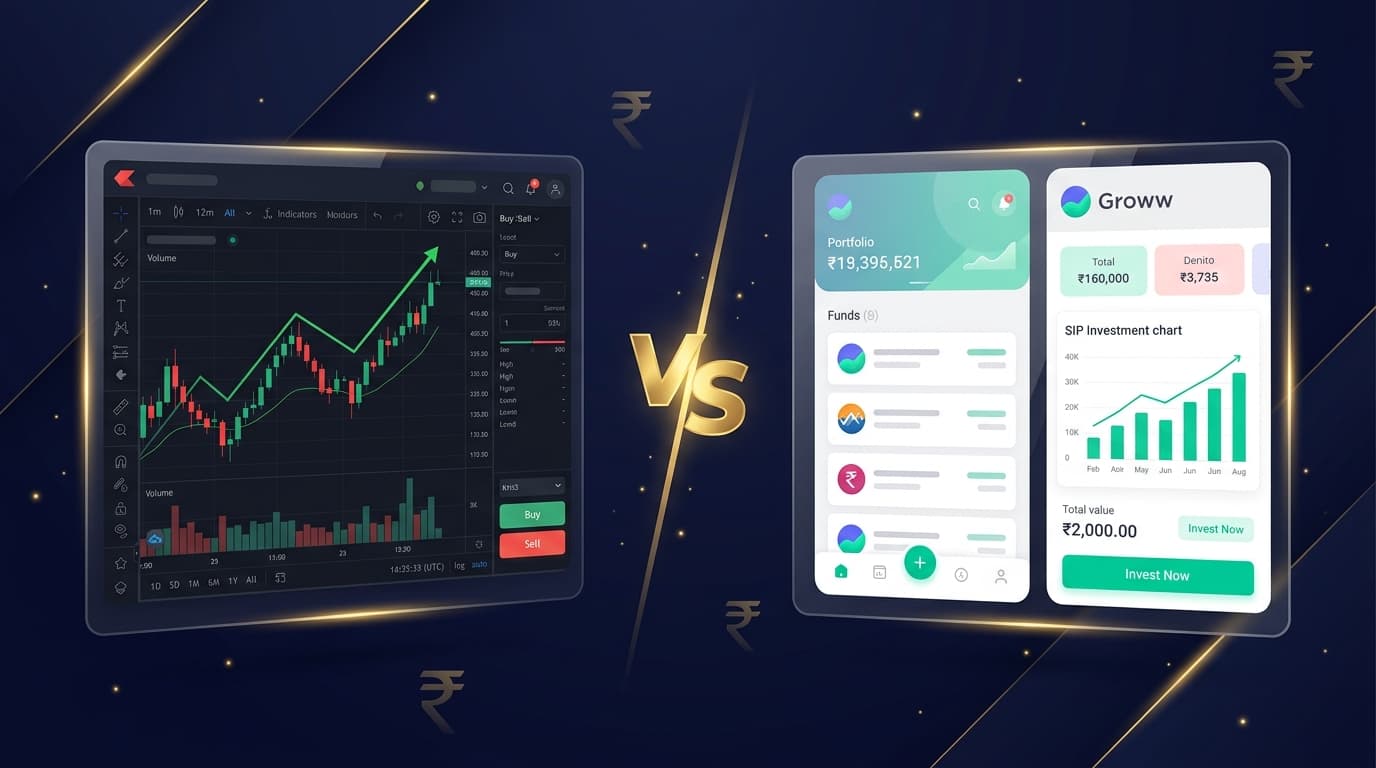
Zerodha vs Groww 2026: Which Broker Should You Actually Use?
This is India's most-searched broker comparison for a reason — both Zerodha and Groww dominate the discount brokerage market, both offer zero delivery brokerage, and both have tens of millions of users. So which one is actually better for you?
The short answer: Zerodha for serious investors and traders. Groww for first-timers who want maximum simplicity and zero fees.
Let's get into the detail that actually matters.
At a Glance: Zerodha vs Groww
| Parameter | Zerodha | Groww |
|---|---|---|
| Account Opening Fee | ₹200 | ₹0 |
| Demat AMC | ₹300/year | ₹0 |
| Equity Delivery | ₹0 | ₹0 |
| Intraday / F&O | ₹20 flat | ₹20 flat |
| Mutual Funds (Direct) | ✅ Zerodha Coin | ✅ Groww |
| IPO Access | ✅ | ✅ |
| Commodity Trading | ✅ | ❌ |
| Currency Trading | ✅ | ❌ |
| Platform | Kite (web + app) | App-first |
| Customer Support | 24–48 hr tickets | Chat, 12–24 hr |
| Active Users | ~13 million | ~11 million |
| Founded | 2010 | 2016 |
💰 Charges: The True Cost
Account Opening
- Zerodha: ₹200 one-time + ₹300/year demat AMC
- Groww: ₹0 opening + ₹0 AMC
Verdict for buy-and-hold investors: Over 5 years, Zerodha costs ₹1,700 more (₹200 + 5×₹300) than Groww in fixed fees alone — before a single trade. For long-term investors who buy monthly SIPs and never trade intraday, Groww is genuinely cheaper.
Verdict for active traders: At 500 trades/year, both cost ₹10,000 in flat brokerage. The AMC difference is immaterial — platform quality and execution speed matter far more.
Hidden Charges (Both Platforms)
Both Zerodha and Groww pass through the same SEBI-mandated charges — these are identical regardless of broker:
| Charge | Rate |
|---|---|
| STT (Securities Transaction Tax) | 0.1% on delivery buy+sell; 0.025% intraday sell |
| Exchange Transaction Charges | ~0.00297% (NSE) |
| GST | 18% on brokerage + exchange charges |
| SEBI Turnover Fee | ₹10 per crore |
| Stamp Duty | 0.015% on buy delivery; 0.003% intraday buy |
| DP Charges (Zerodha) | ₹13.5 per scrip per day for delivery sell |
| DP Charges (Groww) | ₹13.5 per scrip per day for delivery sell |
Key point: DP charges of ₹13.5 per scrip are charged by CDSL on every delivery sell, regardless of broker. This is often misunderstood — it's not a "Zerodha fee" or a "Groww fee," it's a depository charge.
📱 Platform: Kite vs Groww App
Enjoyed this post?
Get our weekly digest delivered free.
This is where the two brokers diverge most meaningfully.
Zerodha Kite
Strengths:
- Best-in-class charting with TradingView integration (50+ indicators, 9 chart types)
- Advanced order types: GTT (Good Till Triggered), AMO (After Market Orders), bracket orders, cover orders
- Market depth (Level 2 data) showing 5 best bid/ask prices
- Kite Connect API — the most documented broker API in India, with 1,000+ open source projects built on it
- Console: comprehensive P&L analytics, tax P&L reports, ledger statements
- Nudge: behavioral finance alerts warning against trading common mistakes
Weaknesses:
- Desktop web is excellent; mobile app feels slightly dense for new users
- No integrated screener — you need external tools (Sensibull, Smallcase)
- The "Kite ecosystem" requires you to use multiple separate products (Kite + Coin + Console + Streak)
Zerodha Kite rating: 9/10 for traders, 7/10 for beginners
Groww App
Strengths:
- Genuinely the cleanest, simplest investing app in India — bar none
- Mutual fund SIP setup in under 3 minutes from account opening
- Stock discovery features: trending stocks, sectoral watchlists, curated portfolios
- Basket orders: buy a predefined mix of stocks in one click (great for Nifty 50 replication)
- Built-in goal planning: "I want ₹50L in 10 years — what SIP do I need?"
- US stocks investing via Vested (Groww-integrated)
Weaknesses:
- Charting tools are basic — no TradingView, limited indicators
- No GTT orders as of 2026
- Platform has gone down on 7 occasions in 2025, including 2 major outages > 4 hours on Budget Day and on an RBI policy day
- No commodity, no currency trading
- F&O experience is usable but lacks the depth of Kite
Groww app rating: 9/10 for beginners, 6/10 for traders
📊 Mutual Funds: Zerodha Coin vs Groww
Both offer direct plan mutual funds at zero commission. Here's the practical difference:
| Feature | Zerodha Coin | Groww |
|---|---|---|
| Plan type | Direct only | Both direct + regular |
| SIP minimum | ₹100 | ₹100 |
| Fund selection | 3,000+ funds | 5,000+ funds |
| SIP date flexibility | Limited dates | Any date |
| Lump sum | ✅ | ✅ |
| STP (Systematic Transfer) | ✅ | ✅ |
| SWP (Systematic Withdrawal) | ✅ | ✅ |
| Goal-based investing | ❌ (separate Coin app) | ✅ (built-in) |
| Consolidated portfolio view | Via Console | Built-in |
Verdict: For mutual funds, Groww has a better MF experience — more fund selection, flexible SIP dates, built-in goal planning. Zerodha Coin works fine but feels like a separate product bolted on.
Important: For the absolute best mutual fund experience, use MyCams or KFintech (direct AMC portals) — zero cost, all direct funds, no intermediary. Use your broker's MF platform only for convenience.
⚠️ Downtime: The Biggest Practical Difference
This is the factor most comparison articles skip over — and it matters enormously.
Zerodha 2025 incidents: 3 platform disruptions, all under 2 hours, during normal trading — not on event days.
Groww 2025 incidents: 7 disruptions, including:
- Budget Day (Feb 2025): 4+ hour outage during the key budget announcement window
- RBI Monetary Policy Day (Aug 2025): 2.5 hour outage
- 5 shorter disruptions of 30–90 minutes
Why this matters: The days when you most want to trade (policy announcements, earnings, global market events) are exactly the days when Groww has historically struggled. If you're an active investor who reacts to news, this is a serious practical concern.
Zerodha's platform reliability is significantly better. They operate at 2x the trading volume and have weathered every Indian market event since 2013 with minimal disruption.
📞 Customer Support
| Aspect | Zerodha | Groww |
|---|---|---|
| Channels | Ticket + Phone (limited hours) | Live chat + Email |
| Response time | 24–48 hours | 12–24 hours |
| Knowledge base | 5,000+ articles (industry best) | 500+ articles |
| Phone support | ❌ (limited) | ❌ |
| Social media | Twitter fairly responsive | Twitter responsive |
| Verdict | Knowledge base saves you | Faster for simple queries |
For common issues (account blocked, fund withdrawal delays, margin queries), Groww's chat is faster — you get a human in 2–4 hours typically. Zerodha's ticket queue runs 24–48 hours, but their Zerodha Help documentation is so thorough that most issues self-resolve.
For complex queries (tax P&L disputes, compliance issues, pledge/unpledge problems), Zerodha's specialized support quality is better.
🎯 Who Should Choose What
Choose Zerodha if you:
- ✅ Trade intraday, F&O, or commodities
- ✅ Want the most reliable platform — especially on volatile days
- ✅ Use TradingView-quality charts and advanced order types
- ✅ Build algorithmic trading strategies (KiteConnect API)
- ✅ Want comprehensive tax P&L and portfolio analytics via Console
- ✅ Plan to invest ₹5L+ — the AMC becomes immaterial at scale
Choose Groww if you:
- ✅ Are opening your first demat account
- ✅ Primarily want to invest in mutual funds (SIPs)
- ✅ Want zero cost — literally ₹0 to open and maintain
- ✅ Prefer mobile-first simplicity over feature depth
- ✅ Want US stocks (via Vested integration)
- ✅ Invest ₹1,000–₹5,000/month and will never trade intraday
The "Both" strategy (what advanced investors actually do):
Many serious Indian investors maintain both accounts:
- Groww for mutual fund SIPs (cleaner UI, more flexible SIP dates)
- Zerodha for all equity and F&O trading (better platform, more reliable)
There's zero SEBI restriction on having multiple demat accounts. Each has its own AMC, but the Groww one is ₹0.
🔍 Head-to-Head: Specific Scenarios
Scenario 1: I want to start a ₹5,000/month SIP in Nifty 50 index fund → Groww wins. Zero cost, cleaner MF UI, more flexible SIP dates.
Scenario 2: I want to buy/sell stocks a few times a month (no intraday) → Tie. Delivery brokerage is ₹0 on both. Zerodha edges for reliability.
Scenario 3: I'm active in options — 50+ trades/month → Zerodha wins. Kite's option chain, GTT orders, and platform reliability are materially better.
Scenario 4: I'm a complete beginner and overwhelmed by financial products → Groww wins. Their onboarding is the best in India.
Scenario 5: I want to invest in US stocks alongside Indian markets → Groww wins. Zerodha doesn't offer US stocks directly.
📋 Final Verdict
| Category | Winner |
|---|---|
| Total cost (beginners) | Groww (₹0 vs ₹200+₹300/yr) |
| Platform reliability | Zerodha |
| Trading tools | Zerodha |
| Mutual funds UX | Groww |
| Customer support speed | Groww |
| F&O + commodities | Zerodha |
| Beginner experience | Groww |
| API + algo trading | Zerodha |
| US stocks | Groww |
| Overall for serious investors | Zerodha |
Bottom line: If you have to pick one — Zerodha for reliability and trading depth, Groww for zero-cost simplicity. The ideal setup is both.
→ Open Zerodha Account | Open Groww Account
Charges verified September 2026. Platform downtime data from public incident logs. This post contains affiliate links — see our Affiliate Disclosure.
The insights, broker reviews, tax estimates, and financial data presented on RupeeIQ are strictly for educational and research purposes only. RupeeIQ and its authors are not SEBI-registered investment advisors or research analysts. Nothing published herein should be construed as personalized investment advice or a recommendation to buy or sell securities. Investments in the securities market are subject to market risks. Please conduct your own due diligence or consult a SEBI-registered financial planner before making investment decisions. Read our Editorial Policy.
Enjoyed this post?
Get our weekly digest delivered free.
Share this post:
RupeeIQ is reader-supported. We may earn a commission from links in this article at no extra cost to you. Read our disclosure.