XIRR vs CAGR for SIP Returns: What's the Difference and Which to Use?
You've been doing your SIP for 3 years. The fund's page shows "CAGR: 18%". But when you check your portfolio value, the returns don't feel like 18%.
You're not miscalculating — CAGR and XIRR measure fundamentally different things. Using the wrong metric gives you a completely distorted picture of your actual wealth creation.
Here's the clear explanation no one gave you when you started investing.
The Core Difference in One Sentence
CAGR measures how much a single lump sum investment grew. XIRR measures your actual personal return when money was added at different times (like a SIP).
What is CAGR?
Compound Annual Growth Rate — the steady annual growth rate that would turn your starting amount into your ending amount.
Formula
CAGR = (Ending Value / Beginning Value) ^ (1/Years) − 1
Example
You invest ₹1,00,000 as a lump sum in Jan 2021. In Jan 2026 (5 years), it's ₹2,49,000.
CAGR = (2,49,000 / 1,00,000) ^ (1/5) − 1
     = (2.49) ^ 0.2 − 1
     = 1.2 ^ ...
     = 20%
The fund grew at 20% CAGR. Simple.
When CAGR is the Right Metric
- Lump sum investments
- Comparing two funds over the same period
- Understanding how a fund has performed in the past
- Evaluating fixed deposits, PPF, NPS (single-point investments)
When CAGR Misleads You
Never use CAGR to evaluate your SIP returns. Here's why:
If you did a ₹10,000/month SIP for 3 years:
- The money invested in Month 1 has been in the fund for 36 months
- The money invested in Month 36 has been in the fund for 1 month
Applying CAGR to this ignores the timing of each investment. The fund's CAGR tells you nothing about your personal return.
What is XIRR?
Enjoyed this post?
Get our weekly digest delivered free.
Extended Internal Rate of Return — the annualised return that accounts for the exact timing and amount of every cash flow (both in and out).
Think of it as: "What single annual interest rate, if applied to each of my deposits on the exact day I made them, would produce my current corpus?"
XIRR is the only correct metric for SIP returns.
Worked Example: Why They Give Different Numbers
Setup
- ₹10,000/month SIP in a fund
- Period: January 2023 to December 2025 (36 months)
- Total invested: ₹3,60,000
- Current value: ₹5,10,000
What CAGR Tells You
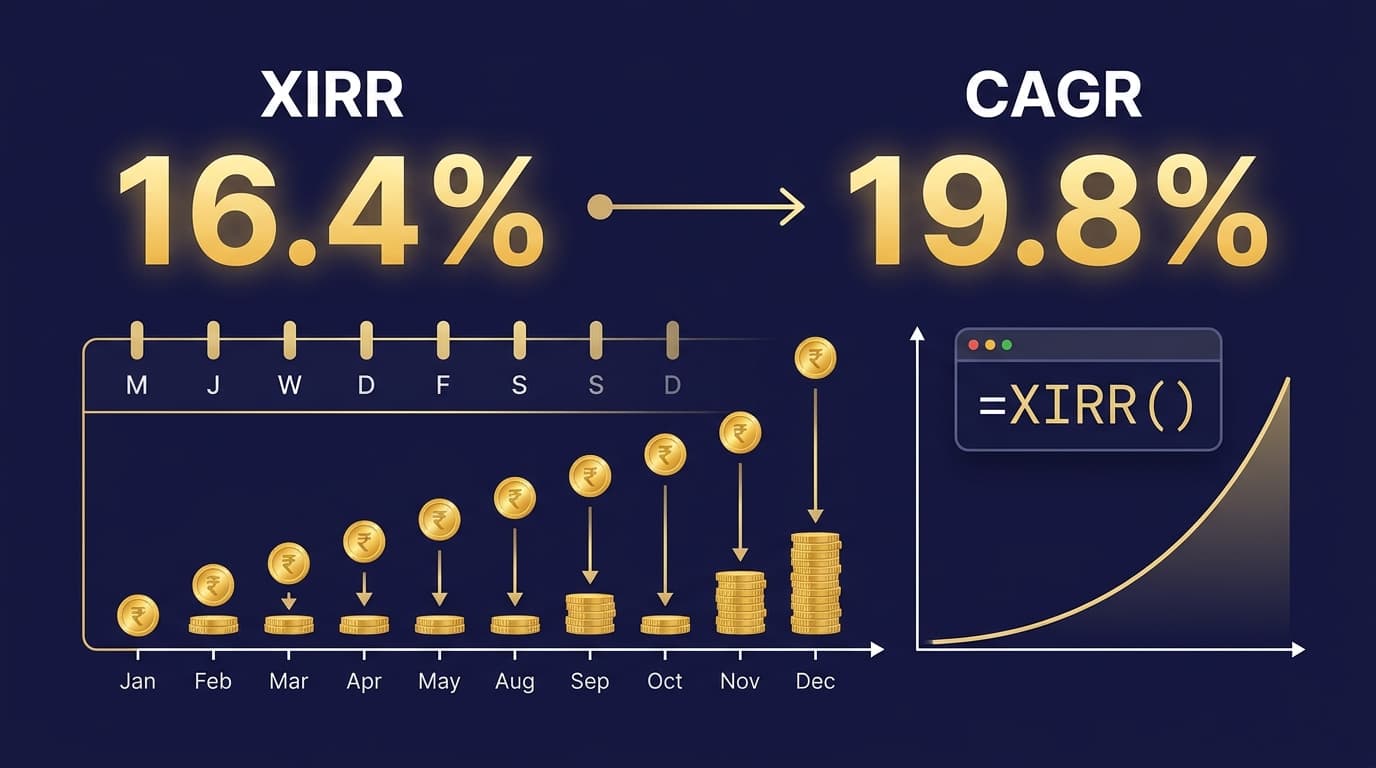
The fund's CAGR over 3 years: 19.8%
If someone asks "how did you do?", you might say 19.8%. But that's the fund's performance, not yours.
What XIRR Tells You
XIRR accounts for the fact that:
- Your Jan 2023 investment of ₹10,000 → grew for 36 months ✅
- Your Dec 2024 investment of ₹10,000 → grew for only 12 months ⚠️
- Your Dec 2025 investment of ₹10,000 → grew for just 1 month 🔴
Your actual XIRR: 16.4%
The gap between 19.8% (fund CAGR) and 16.4% (your XIRR) exists because your later installments had less time to compound. This is normal — not a problem with the fund.
Scenario Analysis: When XIRR vs CAGR Diverge Most
| Market Scenario | Fund CAGR | Your XIRR | Why |
|---|---|---|---|
| Markets rose strongly early, flat later | 18% | 22% | Your early money compounded longest |
| Markets were flat early, surged recently | 18% | 12% | Most money entered near peak |
| Steady growth throughout | 18% | ~17% | Normal SIP drag |
| Markets fell then recovered | 14% | 18% | SIPs bought cheap during dip |
The most dangerous scenario: markets surged recently after years of flat performance. Your fund's CAGR looks great. Your XIRR is much lower because most of your money entered late.
How to Calculate XIRR in Excel (Step-by-Step)
Step 1: Create Two Columns
| Column A: Date | Column B: Amount |
|---|---|
| 01-Jan-2023 | -10000 |
| 01-Feb-2023 | -10000 |
| ... | ... |
| 01-Dec-2025 | -10000 |
| 28-Sep-2026 | +510000 |
Key rule: Investments (money going OUT of your pocket) are negative. Final value (money coming back) is positive.
Step 2: Apply the XIRR Formula
In any empty cell:
=XIRR(B1:B37, A1:A37)
Where:
B1:B37= all cash flows (negative for investments, positive for current value)A1:A37= corresponding dates
Excel returns the XIRR as a decimal — multiply by 100 for percentage.
Step 3: Interpreting the Result
- XIRR of 0.164 = 16.4% annualised return
- This is your actual personal return, accounting for all timing
Absolute Return vs XIRR vs CAGR — Full Comparison
| Metric | Formula | Best For | Limitation |
|---|---|---|---|
| Absolute Return | (Current − Invested) / Invested × 100 | Quick check | Ignores time |
| CAGR | (End/Start)^(1/years) − 1 | Lump sums, fund comparison | Wrong for SIPs |
| XIRR | IRR adjusted for exact dates | SIPs, partial redemptions, top-ups | Needs Excel/tool |
Example: Same Investment, Three Different Numbers
Invested ₹3,60,000 over 3 years via SIP. Current value ₹5,10,000.
- Absolute Return: (5,10,000 − 3,60,000) / 3,60,000 = 41.7% (sounds amazing — ignores time)
- Fund CAGR: 19.8% (the fund's performance — not your personal return)
- Your XIRR: 16.4% (your actual annualised return — the real number)
Quick XIRR Calculator (Without Excel)
Several free tools calculate XIRR without Excel:
- Groww app → Portfolio → Returns → Switch to "XIRR" mode
- Kuvera.in → automatically shows XIRR for every fund
- INDmoney → portfolio tracker shows XIRR
- Zerodha Console → Tax P&L section shows XIRR
- Value Research Online → portfolio tool calculates XIRR
If you use Zerodha, Groww, or any modern platform, your portfolio XIRR is already calculated for you — just look for the right toggle.
Common XIRR Mistakes
Mistake 1: Not Including the Final Value as Positive
If you include only your SIP payments (all negative) and forget to add the current portfolio value as a positive number on today's date, Excel will throw an error or return a nonsensical result.
Mistake 2: Using the Same Date for All Transactions
XIRR's entire value comes from different dates. If you enter all transactions with the same date, it collapses to a simple return — use actual transaction dates.
Mistake 3: Comparing Your XIRR to Fund CAGR
They measure different things. Compare your XIRR to:
- XIRR of a benchmark (e.g., what would ₹10K/month in NIFTY 50 index have returned?)
- Your other fund's XIRR
Mistake 4: Short-Period XIRR
XIRR for periods under 1 year is unreliable and often extreme (hundreds of percent or deeply negative). Use absolute returns for periods under 12 months.
When Does Your XIRR Match the Fund's CAGR?
Never exactly, but they converge when:
- Your SIP is very old (10+ years) — averaging out evens the timing effect
- You did a lump sum (not a SIP)
- Markets grew at a perfectly constant rate (never happens in reality)
Summary
| Question | Answer |
|---|---|
| "How has this fund performed?" | Use CAGR (point-to-point, same start/end date) |
| "How am I personally performing on my SIP?" | Use XIRR |
| "Should my return match the fund's CAGR?" | No — and now you know why |
| "Which is the more honest return metric for SIP investors?" | XIRR, always |
If your fund's 3-year CAGR is 20% but your XIRR is 15%, that's perfectly normal. It means the fund performed well — but you started your SIP at a specific point in time that affected your personal returns.
The right question isn't "why is my XIRR lower than CAGR?" — it's "is my XIRR acceptable for the risk I took?"
A 14–16% XIRR over 5+ years in an equity fund is excellent. That's how real wealth is built.
The insights, broker reviews, tax estimates, and financial data presented on RupeeIQ are strictly for educational and research purposes only. RupeeIQ and its authors are not SEBI-registered investment advisors or research analysts. Nothing published herein should be construed as personalized investment advice or a recommendation to buy or sell securities. Investments in the securities market are subject to market risks. Please conduct your own due diligence or consult a SEBI-registered financial planner before making investment decisions. Read our Editorial Policy.
Enjoyed this post?
Get our weekly digest delivered free.
Share this post:
RupeeIQ is reader-supported. We may earn a commission from links in this article at no extra cost to you. Read our disclosure.