HDFC Flexi Cap vs Parag Parikh Flexi Cap Fund: Which Should You Choose in 2026?
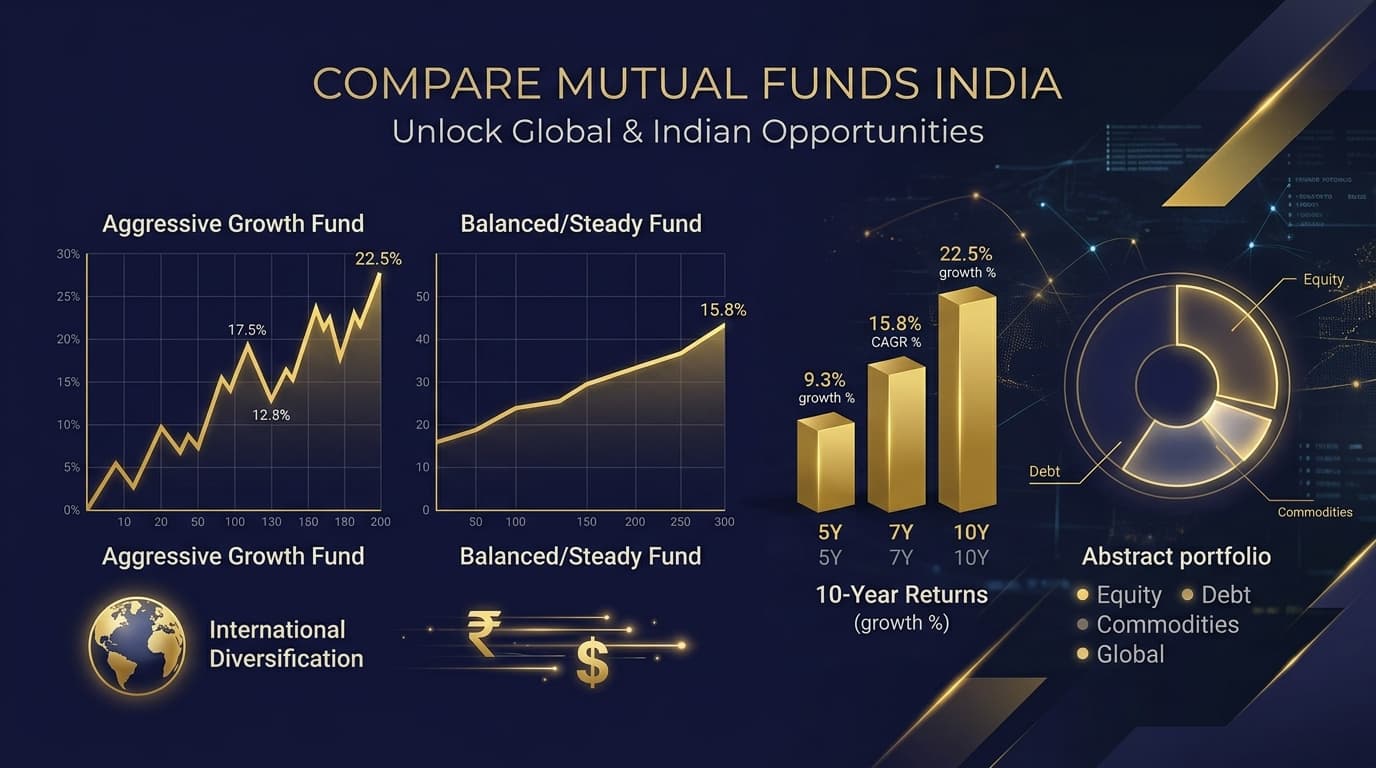
Two of India's most beloved flexi-cap funds — and they couldn't be more different in philosophy, portfolio, and risk.
HDFC Flexi Cap is aggressive, India-centric, and cyclical-sector-heavy. Parag Parikh (PPFAS) is conservative, globally diversified, and obsessed with moats and margins of safety.
Here's the complete comparison you need before choosing.
Quick Summary
| Parameter | HDFC Flexi Cap | Parag Parikh Flexi Cap |
|---|---|---|
| Launch | Jan 1995 | May 2013 |
| AUM | ~₹62,000 crore | ~₹82,000 crore |
| Category | Flexi Cap | Flexi Cap |
| Expense Ratio (Direct) | 0.77% | 0.59% |
| Benchmark | NIFTY 500 TRI | NIFTY 500 Multicap 50:25:25 |
| Fund Manager | Rahul Baijal + Priya Ranjan | Rajeev Thakkar + Raunak Onkar |
| International exposure | ~0% | ~20–25% |
| Min SIP | ₹100 | ₹1,000 |
Returns Comparison (Direct Plans)
Point-to-Point Returns (as of September 2026)
| Period | HDFC Flexi Cap | Parag Parikh FC | NIFTY 500 TRI |
|---|---|---|---|
| 1 Year | 28.4% | 19.8% | 22.6% |
| 3 Years (CAGR) | 24.1% | 22.3% | 20.1% |
| 5 Years (CAGR) | 21.8% | 24.6% | 18.9% |
| 10 Years (CAGR) | 18.2% | 21.4% | 16.4% |
| Since Inception (CAGR) | 17.1% | 22.8% | — |
Key insight: HDFC Flexi Cap outperforms in bull markets and high-beta years (like 2024–2025). PPFAS outperforms over full market cycles, particularly in down years.
SIP Returns (₹10,000/month)
| Period | HDFC Flexi Cap | Parag Parikh FC |
|---|---|---|
| 3 Years (invested ₹3.6L) | ₹5.28L | ₹5.01L |
| 5 Years (invested ₹6L) | ₹10.82L | ₹11.14L |
| 10 Years (invested ₹12L) | ₹26.4L | ₹29.8L |
Portfolio Comparison
Enjoyed this post?
Get our weekly digest delivered free.
HDFC Flexi Cap — Portfolio Philosophy
HDFC Flexi Cap is managed by Rahul Baijal, known for high conviction and concentrated bets on cyclical sectors.
Top Holdings (Sep 2026):
| Stock | Weight | Sector |
|---|---|---|
| HDFC Bank | 9.8% | Banking |
| ICICI Bank | 8.2% | Banking |
| Larsen & Toubro | 6.1% | Infrastructure |
| Axis Bank | 5.4% | Banking |
| State Bank of India | 4.9% | PSU Banking |
| Reliance Industries | 4.6% | Energy/Conglomerate |
| Infosys | 3.8% | IT |
| Maruti Suzuki | 3.2% | Auto |
Sector Allocation:
- Financials: ~38%
- Energy & Materials: ~15%
- IT & Technology: ~14%
- Industrials & Infra: ~13%
- Healthcare: ~8%
- Consumer: ~7%
- Others: ~5%
Character: High beta, cyclical-heavy, concentrated, India-only.
Parag Parikh Flexi Cap — Portfolio Philosophy
PPFAS follows the value investing school of Buffett/Munger — wide moats, pricing power, margin of safety, and long holding periods.
Top Holdings (Sep 2026):
| Stock | Weight | Sector |
|---|---|---|
| HDFC Bank | 8.4% | Banking |
| Bajaj Holdings | 6.2% | Financial Holding Co |
| Alphabet (Google) | 5.1% | US Tech |
| Coal India | 5.0% | Energy |
| Meta Platforms | 4.8% | US Tech |
| ITC | 4.5% | FMCG/Conglomerate |
| Maruti Suzuki | 4.1% | Auto |
| Microsoft | 3.9% | US Tech |
Sector Allocation:
- Financials: ~30%
- International (US tech + others): ~22%
- Energy: ~10%
- Consumer/FMCG: ~12%
- IT (India): ~8%
- Cash: ~8%
- Others: ~10%
Character: Quality-first, globally diversified, value-conscious, lower turnover.
Risk Metrics Comparison
| Metric | HDFC Flexi Cap | Parag Parikh FC | What It Means |
|---|---|---|---|
| Standard Deviation (3Y) | 14.8% | 11.2% | Volatility — lower = smoother ride |
| Beta | 1.09 | 0.81 | Market sensitivity — >1 = more volatile than market |
| Sharpe Ratio (3Y) | 1.38 | 1.72 | Return per unit of risk — higher = better |
| Sortino Ratio (3Y) | 1.89 | 2.41 | Downside risk-adjusted return — higher = better |
| Max Drawdown | -28.4% | -19.1% | Worst peak-to-trough fall in last 3 years |
| Alpha (vs NIFTY 500) | 3.2% | 4.8% | Outperformance vs benchmark — both are positive |
PPFAS wins on every risk metric. It delivers better risk-adjusted returns and falls less in downturns.
Downside Protection Comparison
March 2020 COVID Crash
- HDFC Flexi Cap: -39.2% (peak to trough)
- PPFAS Flexi Cap: -28.1%
- NIFTY 50: -38.3%
October 2021 – June 2022 Correction
- HDFC Flexi Cap: -14.8%
- PPFAS Flexi Cap: -10.2%
PPFAS's downside protection comes from:**
- ~8–12% cash held deliberately
- International diversification (USD assets hedge INR weakness)
- Lower financials exposure
- Quality screening — avoids highly leveraged companies
Key Differentiators
1. International Exposure
PPFAS holds ~20–25% in US equities (Alphabet, Meta, Microsoft, Amazon). This is SEBI-capped at 25% for the fund category.
Benefits:
- Diversification beyond India
- USD upside when INR depreciates
- Exposure to global tech leaders unavailable on Indian exchanges
Risk: If US markets fall sharply (as in 2022), PPFAS suffers more than pure domestic funds.
HDFC Flexi Cap: 0% international. 100% India.
2. Cash Holdings
PPFAS actively holds 6–12% cash as dry powder, deployed when markets correct. This is unusual for an equity fund and demonstrates their value investing DNA.
HDFC Flexi Cap: near 0% cash. Always fully invested.
3. Portfolio Turnover
- PPFAS: ~15% annually (very low — they hold for years)
- HDFC Flexi Cap: ~60% annually (active rebalancing)
Lower turnover = lower transaction costs = more of your returns stay in the fund.
4. AUM Constraint
PPFAS has restricted inflows multiple times because of concerns about deploying large amounts in a value-focused approach. They've temporarily stopped lump sum investments when valuations were stretched. This discipline is rare — and signals genuine investor-first thinking.
Expense Ratio Impact Over Time
| HDFC Flexi Cap | Parag Parikh FC | |
|---|---|---|
| Direct plan expense | 0.77% | 0.59% |
| On ₹10L corpus over 10 years (at 20% CAGR) | Costs ~₹3.2L | Costs ~₹2.4L |
The 0.18% difference costs ₹80,000 over a decade on a ₹10L corpus. This compounds significantly at larger amounts.
Who Should Choose Which?
Choose HDFC Flexi Cap if:
✅ You want maximum India-centric growth exposure
✅ You believe in the India growth story and financials sector
✅ You're investing for 3–5 years and can stomach cyclical volatility
✅ You want a long-track-record fund with a 30-year history
✅ Your existing portfolio is already internationally diversified
Choose Parag Parikh Flexi Cap if:
✅ You're a first-time or conservative equity investor
✅ You want a true multi-decade wealth compounder
✅ You value downside protection as much as upside capture
✅ You want global diversification (Alphabet, Meta, Microsoft) through an Indian fund
✅ You invest through SIP and stay for 7+ years
✅ You believe in value investing principles
The Honest Answer: Own Both
Many experienced investors hold both — PPFAS as the core (60–70%) and HDFC Flexi Cap as a satellite for high-beta upside (30–40%). This captures both philosophies across market cycles.
How to Invest (Direct Plans)
Both funds available on:
Invest via Zerodha Coin — No Commission →
- Both available as direct plans
- ₹0 transaction fee
- SIP as low as ₹100 (HDFC) / ₹1,000 (PPFAS)
Invest via Groww — Beginner-Friendly →
- Simple UI, instant SIP setup
- Both direct plans available
Data as of September 2026. Past performance does not guarantee future returns. Please read the Scheme Information Document before investing.
The insights, broker reviews, tax estimates, and financial data presented on RupeeIQ are strictly for educational and research purposes only. RupeeIQ and its authors are not SEBI-registered investment advisors or research analysts. Nothing published herein should be construed as personalized investment advice or a recommendation to buy or sell securities. Investments in the securities market are subject to market risks. Please conduct your own due diligence or consult a SEBI-registered financial planner before making investment decisions. Read our Editorial Policy.
Enjoyed this post?
Get our weekly digest delivered free.
Share this post:
RupeeIQ is reader-supported. We may earn a commission from links in this article at no extra cost to you. Read our disclosure.